10 Chesterfield Sofa Living Room Ideas That Feel Fresh and Easy
You just brought home a Chesterfield sofa, and now the rest of the room feels like it's waiting for a memo. That tufted back and rolled arms make a statement, but they can also make everything else look a little plain. The good news?
You don't need a designer budget to pull the room together. A few smart swaps and layout tweaks can turn that classic piece into the anchor of a relaxed, modern space.
Think about how you actually use the room—movie nights, coffee with friends, or just scrolling on your phone. The ideas ahead keep things practical, so you can try one or two without redoing the whole house.
1. Pair Your Chesterfield with a Soft, Neutral Rug
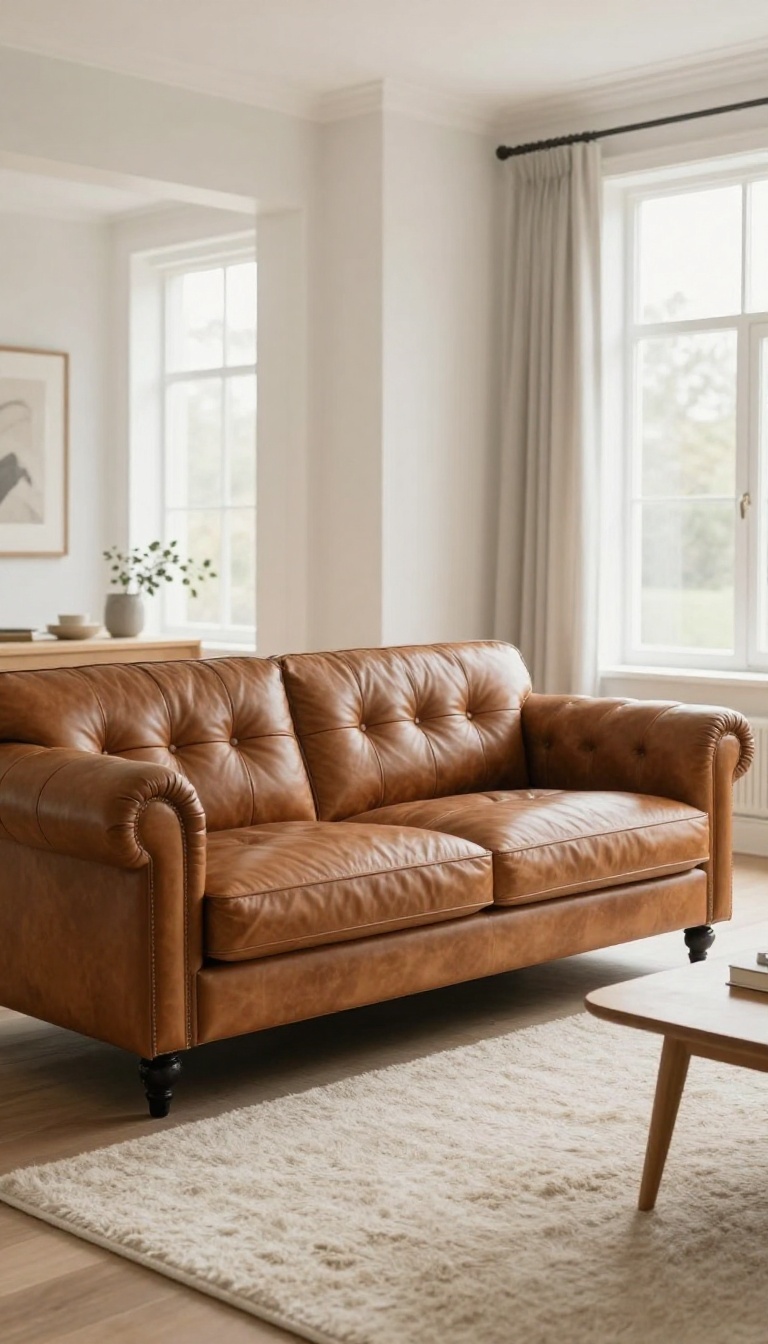
A Chesterfield has a lot of personality—button tufting, rolled arms, and a silhouette that demands attention. That's great, but it can also make a room feel a bit stiff. The quickest fix?
Slide a soft, neutral rug underneath it. Think cream, oatmeal, or light gray. These shades don't compete with the sofa; they calm it down.
Plus, a plush texture underfoot adds warmth that balances the sofa's formality. You're not trying to hide the Chesterfield—you're giving it a softer stage. The right rug makes the whole seating area feel more inviting and less like a museum piece.
Choosing the right rug isn't complicated, but a few details make a big difference. You want something that feels good to walk on and looks intentional with your sofa's leather or fabric. Start with the material.
Wool, jute, or a low-pile blend works well because they're durable and add subtle texture. Avoid anything too shiny or busy—patterns can fight with the tufting. Size matters more than you think.
A rug that's too small makes the sofa look like it's floating. Aim for at least the front legs of the Chesterfield to sit on the rug, or go larger if the room allows. Color-wise, stick to neutrals.
Cream, oatmeal, light gray, or even a soft taupe. These tones create a quiet backdrop that lets the sofa's details shine without feeling heavy. Finally, don't forget the rug pad.
It keeps things from sliding and adds an extra layer of cushioning. A small upgrade that makes a big difference.
Why Neutrals Work Best
Neutral rugs don't compete with the Chesterfield's strong lines. They create contrast without clashing, so the sofa remains the star. Plus, neutral shades make the room feel larger and brighter.
Texture Over Pattern
A subtle texture—like a chunky knit or a woven jute—adds depth without visual noise. Save patterns for pillows or art. The rug should feel calm, not chaotic.
Getting The Size Right
Measure your space before you buy. A rug that's too small shrinks the whole seating area. When in doubt, go bigger—it'll make the room feel more cohesive.
2. Mix in a Modern Accent Chair
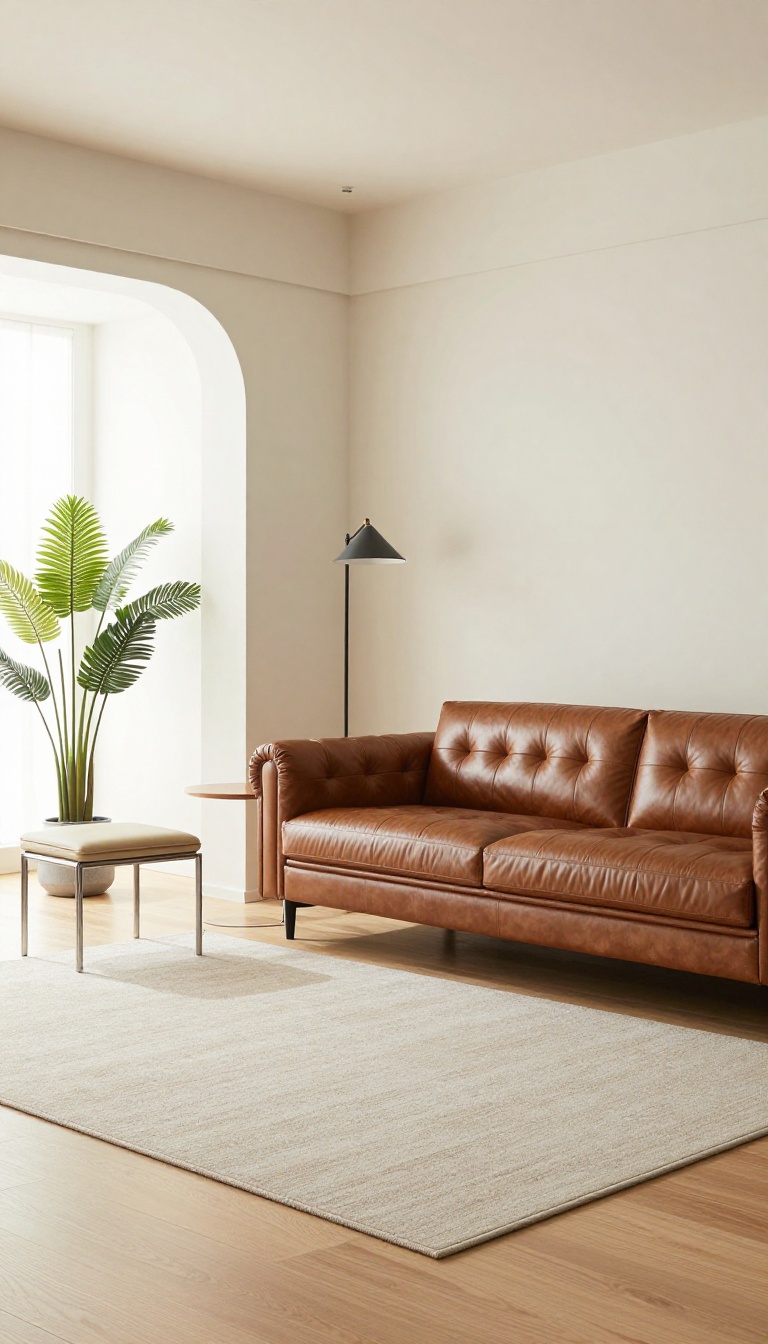
A Chesterfield already brings plenty of old-world charm, so the quickest way to keep it from feeling stuffy is to pair it with something clean and current. A modern accent chair does exactly that. It breaks up the traditional look without fighting it, and suddenly the room feels collected instead of themed.
The trick is contrast. You want the chair to feel like it belongs in the same conversation as your sofa, but not like it was bought in the same decade. That tension is what makes the room look intentional and fresh.
Pick A Material That Pushes Back
Your Chesterfield is probably leather or a heavy fabric with lots of texture. A sleek chair in smooth leather, polished metal, or even clear acrylic creates an instant modern edge. Think of a slim leather sling chair or a minimalist metal frame with a cushioned seat.
The mix of old and new materials keeps the eye moving and stops the room from feeling like a museum.
Keep The Silhouette Simple
Skip the rolled arms and tufting on the accent chair. Go for straight lines, a low back, or a geometric shape. A simple silhouette lets the Chesterfield stay the star while the chair adds a cool, contemporary note.
It also makes the chair easier to move around when you want to change up the layout.
Place It For Balance, Not Symmetry
You don't need a matching pair. One accent chair angled toward the sofa creates a cozy conversation area without looking too formal. Put it slightly off-center, maybe near a window or a floor lamp, so it feels like it landed there naturally.
That casual placement is what makes the whole room feel easy and lived-in.
3. Go Bold with a Jewel-Tone Throw
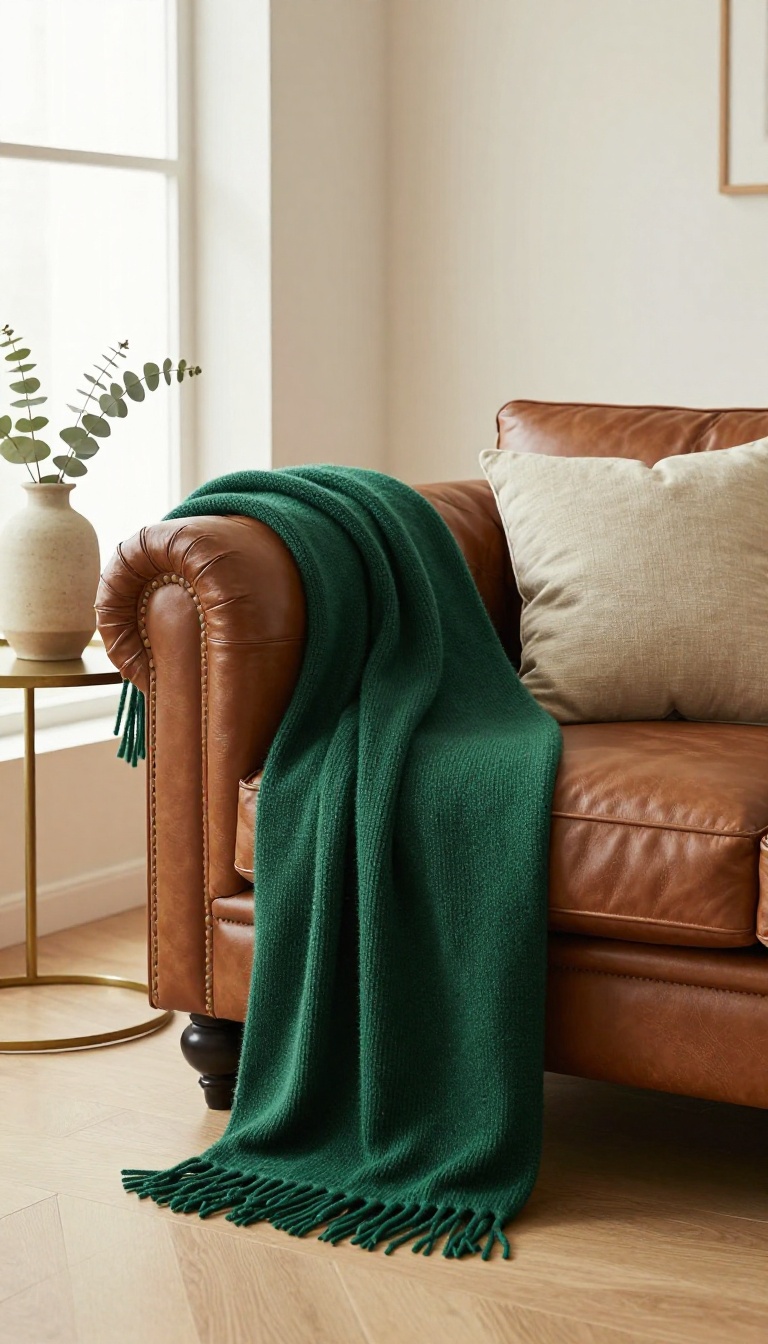
A single jewel-tone throw can wake up a Chesterfield without a major commitment. Drape a rich emerald or sapphire blanket over one arm and you get an instant hit of color that feels intentional, not permanent. It’s the easiest way to test a bolder palette before you buy curtains or repaint.
Jewel tones work because they’re deep and saturated, so they hold their own against the sofa’s heavy silhouette. Emerald, sapphire, amethyst, and ruby all read as luxurious without being loud. And since it’s just a throw, you can swap it out seasonally or when you get bored.
The key is to treat the throw as a deliberate accent, not a random blanket. Fold it neatly, let it cascade down one arm, and keep the rest of the sofa clear. That way the eye lands on the color exactly where you want it.
Pick A Shade That Plays Well With Your Sofa
If your Chesterfield is neutral—tan, gray, cream—almost any jewel tone will pop. Emerald adds a cool, botanical feel; sapphire brings a calm, moody vibe; ruby warms things up. For a leather sofa in cognac or brown, try emerald or sapphire to create contrast without clashing.
If your sofa is already dark, go for a brighter jewel like amethyst or fuchsia to keep the look from getting too heavy.
Style It So It Looks Intentional
Don’t just toss the throw—fold it in thirds lengthwise, then drape it over one arm so it hangs about a third of the way down. Let the fringe or tassels show if it has them. You can also bunch it slightly at the corner for a relaxed, lived-in look.
The goal is a casual drape that still looks like you meant it.
Balance The Rest Of The Room
Once the throw is in place, echo that color somewhere else—a couple of pillow covers, a candle, or a small vase. You don’t need much; just one or two repeats make the whole room feel cohesive. Keep other patterns quiet so the jewel tone stays the star.
4. Swap Heavy Curtains for Light Linen
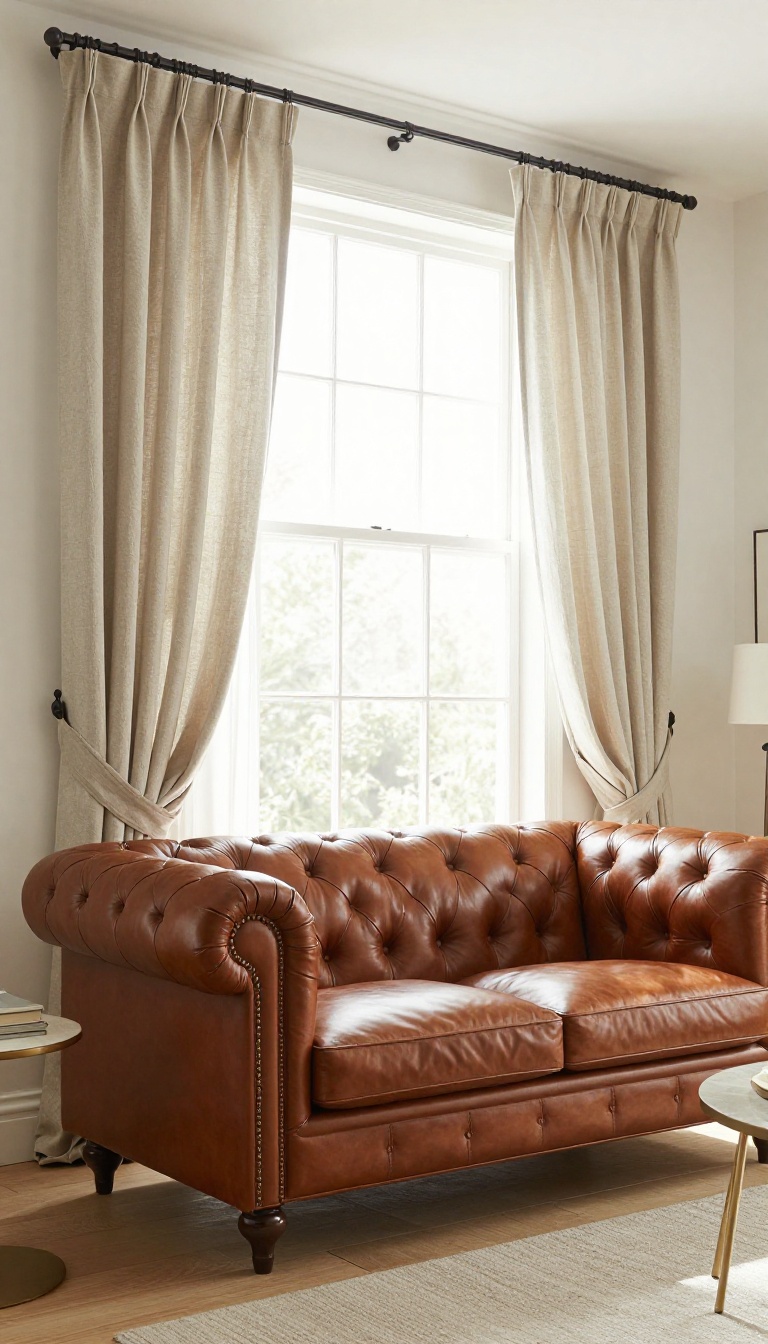
Heavy drapes can make a Chesterfield feel like it belongs in a museum. Swap them for light linen panels, and the whole room breathes easier. You get softness without the weight, and your sofa still looks like the star.
Linen curtains filter sunlight instead of blocking it out. That glow makes the tufting on your Chesterfield look textured and inviting, not dark and formal. The fabric also hangs with a relaxed, slightly rumpled vibe that pairs perfectly with leather or velvet.
You don't have to ditch curtains entirely. Just choose a lighter material and a simpler rod. The goal is to keep the window feeling open, even when the panels are drawn.
Pick The Right Fabric Weight
Go for linen or a linen-cotton blend. These fabrics let some light through and drape softly. Avoid heavy velvet or blackout liners unless you really need them.
A lightweight panel in a neutral tone like oatmeal, soft white, or pale gray keeps the focus on your sofa.
Hang Them High And Wide
Mount the rod close to the ceiling and extend it a few inches past the window frame. This trick makes the room feel taller and the window bigger. It also gives your Chesterfield more visual space to breathe.
Use simple rings or a slim rod to keep the look airy.
Let The Light Do The Work
During the day, pull the panels to the sides and let sunlight wash over the room. The natural light softens the deep button tufting and makes the whole space feel casual. At night, close them for privacy, but the lighter fabric still keeps things from feeling closed in.
5. Add a Slim Console Behind the Sofa
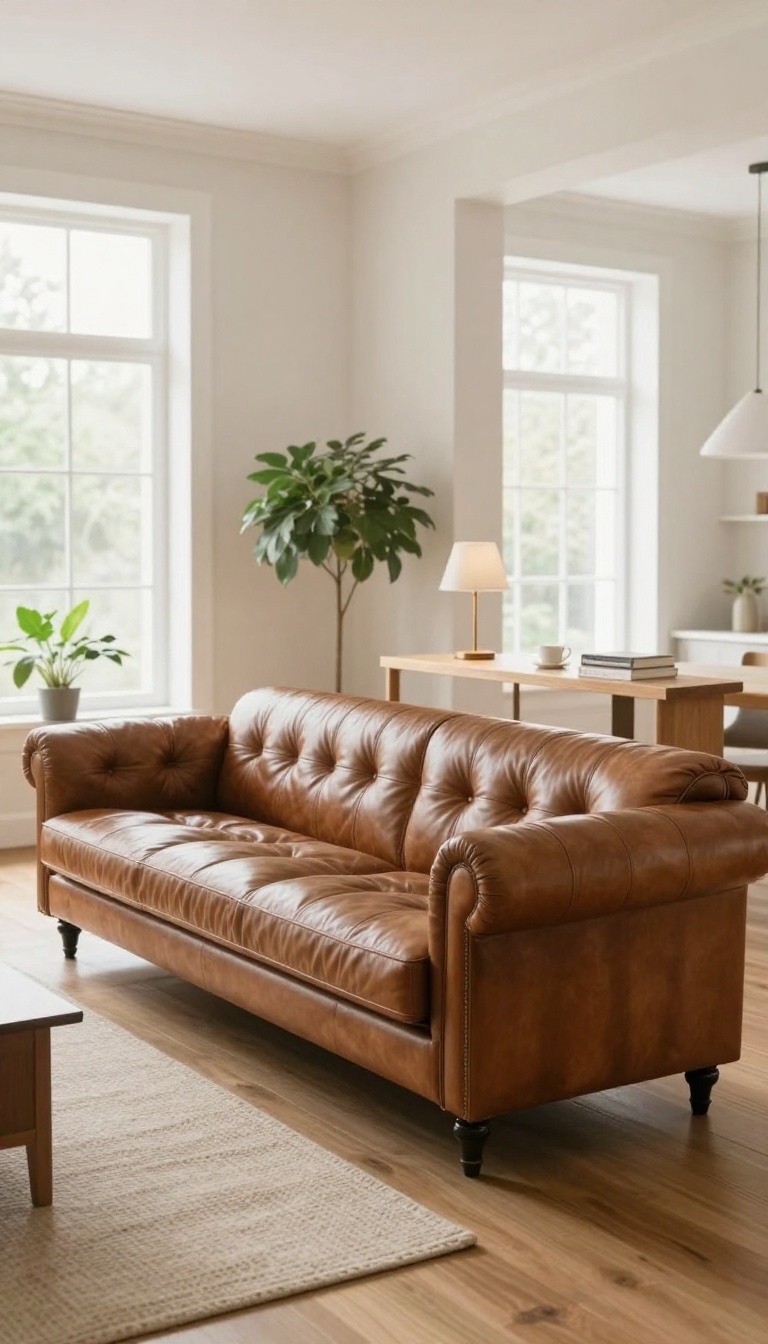
A slim console table tucked behind your Chesterfield solves a handful of problems at once. It gives you a spot for a lamp, a place to set your coffee, and a visual buffer if the sofa floats in an open-plan room. The trick is keeping it narrow.
You want enough surface to be useful, but not so deep that it crowds the walkway or makes the sofa feel boxed in. Look for something around 12 to 14 inches deep, and match the console's length to the sofa or go slightly shorter. Once it's in place, you've basically created a mini zone that works for reading, entertaining, or just keeping clutter off the coffee table.
It's a small addition that changes how the whole room functions.
A console behind the sofa is one of those moves that looks intentional even when you throw it together on a Saturday afternoon. It adds a layer without blocking sightlines, and it gives your Chesterfield a little breathing room from the wall or the back of the room. If your sofa sits in the middle of an open-plan space, this is almost a must.
The console acts like a low wall, separating the living area from the dining table or kitchen without making anything feel closed off. You still get that open flow, but the sofa now has a clear home base. Style-wise, keep the console simple.
A plain wood or metal frame won't compete with the tufting and curves of the Chesterfield. You're adding function, not another diva.
Pick The Right Height And Depth
You want the console to sit just below or level with the back of the sofa. If it's too tall, it looks like a random shelf floating behind you. Too short, and it disappears.
Depth matters just as much. Anything deeper than 14 inches starts to feel like a desk. Measure your walkway first—you should still have at least 24 inches of clear space to pass through comfortably.
Style It Without Clutter
A pair of matching lamps is the classic move, and it works because it frames the sofa symmetrically. If lamps aren't your thing, try a small tray for drinks, a stack of books, or a single vase with fresh stems. Leave some empty space.
The console should look curated, not crammed. A few well-chosen pieces beat a surface full of knickknacks every time.
Make It Work In Open-plan Rooms
When your sofa floats, the console becomes a subtle divider. You can use it to define the living zone without adding a screen or a rug edge. Keep the back side of the console neat, since people will see it from the kitchen or dining area.
A finished back or a simple basket for throws can make that side look just as good as the front.
6. Layer in a Gallery Wall with Personal Photos
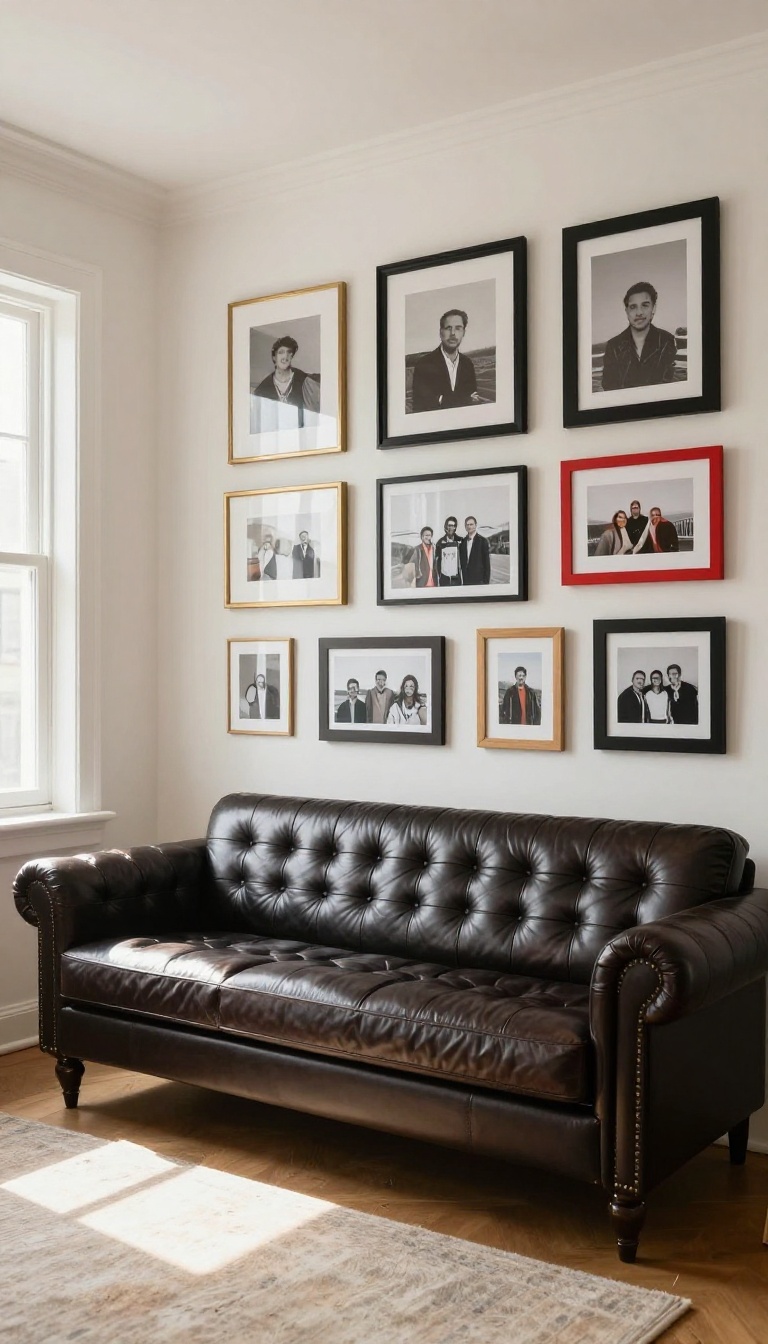
A Chesterfield's buttoned back is a beautiful thing, but it can also feel a bit formal and closed off. A gallery wall changes that in a hurry. By mixing framed snapshots, art prints, and a few oddball finds, you break up that uniform tufting and make the whole room feel like yours.
The best part? You don't need a curator's eye. You just need a loose plan and a willingness to play.
Start by thinking about the wall behind or beside your sofa. That's prime real estate for a gallery wall because it's already a focal point. The goal is to soften the sofa's strict lines with a collection that looks collected over time, not bought in one afternoon.
You can go floor-to-ceiling or keep it contained to a small cluster. Either way, the mix of sizes and subjects keeps things interesting. And because Chesterfields tend to be dark or heavily textured, lighter frames and mats will pop nicely against them.
Mix Frames And Sizes
Don't buy a matching set of frames. That's the fastest way to make a gallery wall look like a showroom display. Instead, gather frames in different finishes—black, brass, natural wood, even a pop of color—and vary the sizes.
A good rule of thumb: start with one large anchor piece, then build around it with smaller ones. Thrift stores and flea markets are goldmines for cheap, interesting frames. Just make sure the arrangement feels balanced, not perfectly symmetrical.
Include Real Life, Not Just Art
This is where the personal touch comes in. Print out those phone photos you never get around to framing—candid shots of friends, travel snapshots, even a funny pet picture. Mix them with a few affordable art prints or a kids' drawing.
The contrast between a formal Chesterfield and a goofy vacation photo is exactly what makes the room feel fresh and lived-in. It tells guests that real people hang out here.
Plan Before You Hammer
Lay everything out on the floor first. Move pieces around until the spacing feels right—usually two to three inches between frames. Take a photo of the layout on your phone, then use that as a guide when you hang.
If you're nervous about committing, try paper templates. Cut out paper the size of each frame, tape them to the wall, and live with it for a day. You'll know pretty quickly if it works.
Keep It Loose And Low-stress
A gallery wall doesn't have to be permanent. Start with five or six frames, then add more over time as you find pieces you love. That way it grows with you and never feels forced.
And if you get tired of it? Rearranging is free. Just patch a few nail holes and start again.
The whole point is to have fun with it, not to create a museum exhibit.
7. Choose a Coffee Table with an Organic Shape
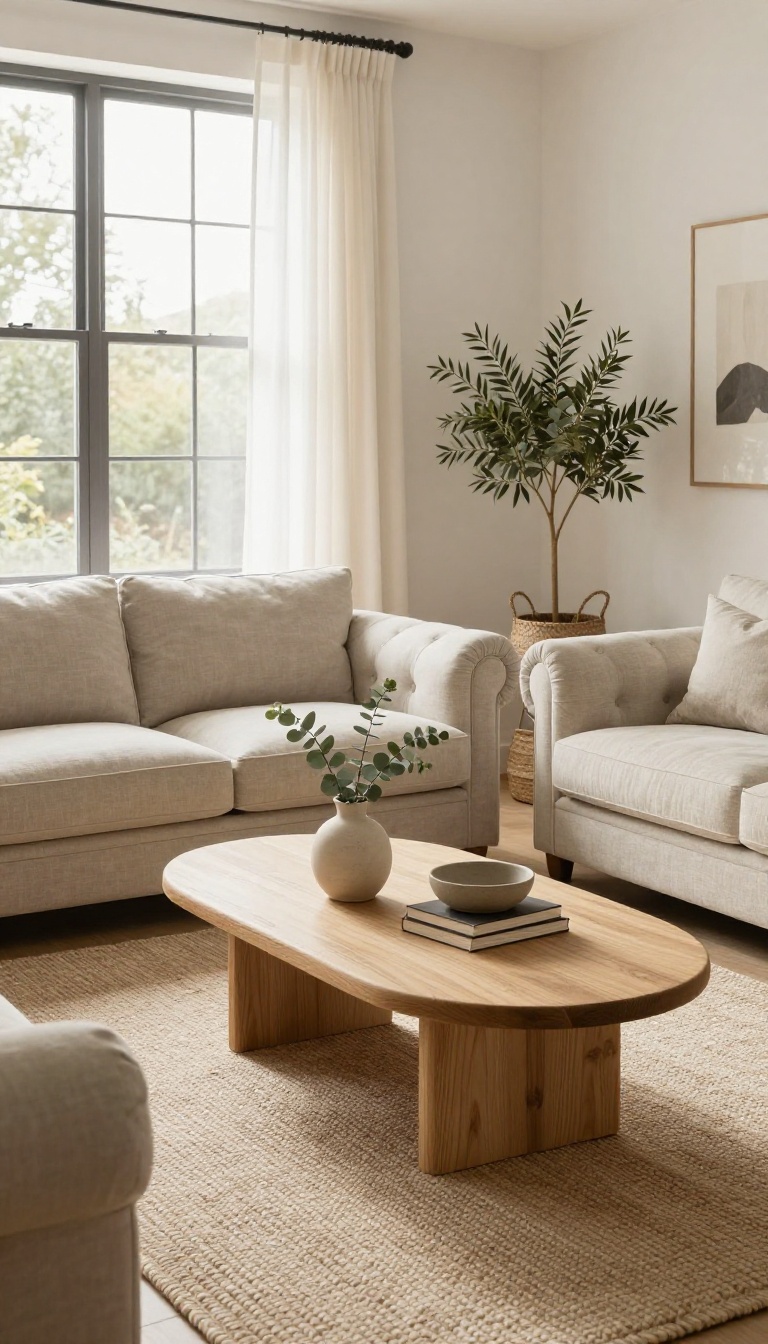
Chesterfield sofas are built on straight lines—rectangular frame, squared cushions, rigid arms. That structure looks sharp, but it can also make a room feel boxy and a little stiff. An oval or round coffee table breaks up all that geometry and instantly softens the mood.
There's a practical payoff, too. Curved tables have no hard corners, so you can move around them without dodging sharp edges. In smaller seating areas, that extra flow makes the whole setup feel more comfortable and less cramped.
The shape of your coffee table matters more than you might think. It's the piece that sits closest to your sofa, so it either echoes the Chesterfield's angles or gently contrasts them. Choosing a curve is one of the easiest ways to keep the room from feeling like a formal parlor.
Why Curves Work
A Chesterfield is all about straight, tailored lines. Add a round or oval table, and suddenly the room has a softer rhythm. The contrast feels intentional, not accidental.
Curves also make tight spaces work better. You can squeeze past a round table without banging your shin on a corner, which matters in smaller living rooms.
Pick The Right Size
A good rule: the table should be about two-thirds the length of your sofa. Too small and it looks lost; too big and you can't reach it comfortably. For a standard Chesterfield, an oval table around 48 to 54 inches long works well.
If your sofa is petite, a 36-inch round table keeps things balanced.
Materials That Fit
You don't have to match the sofa's leather or velvet. In fact, mixing materials keeps the room from feeling too themed. Try a light wood oval table for warmth, a marble round for a touch of polish, or a woven rattan top if you want a relaxed, breezy vibe.
Glass works too, but it can feel a bit cold next to a heavy Chesterfield.
Styling The Curve
Round tables are forgiving to style. A single low bowl or a small stack of books in the center keeps the curve visible. Skip the tall vase—it blocks sightlines and makes the table feel crowded.
A couple of short candles or a small tray with remotes keeps it useful without hiding the shape.
8. Use a Large Plant to Add Life
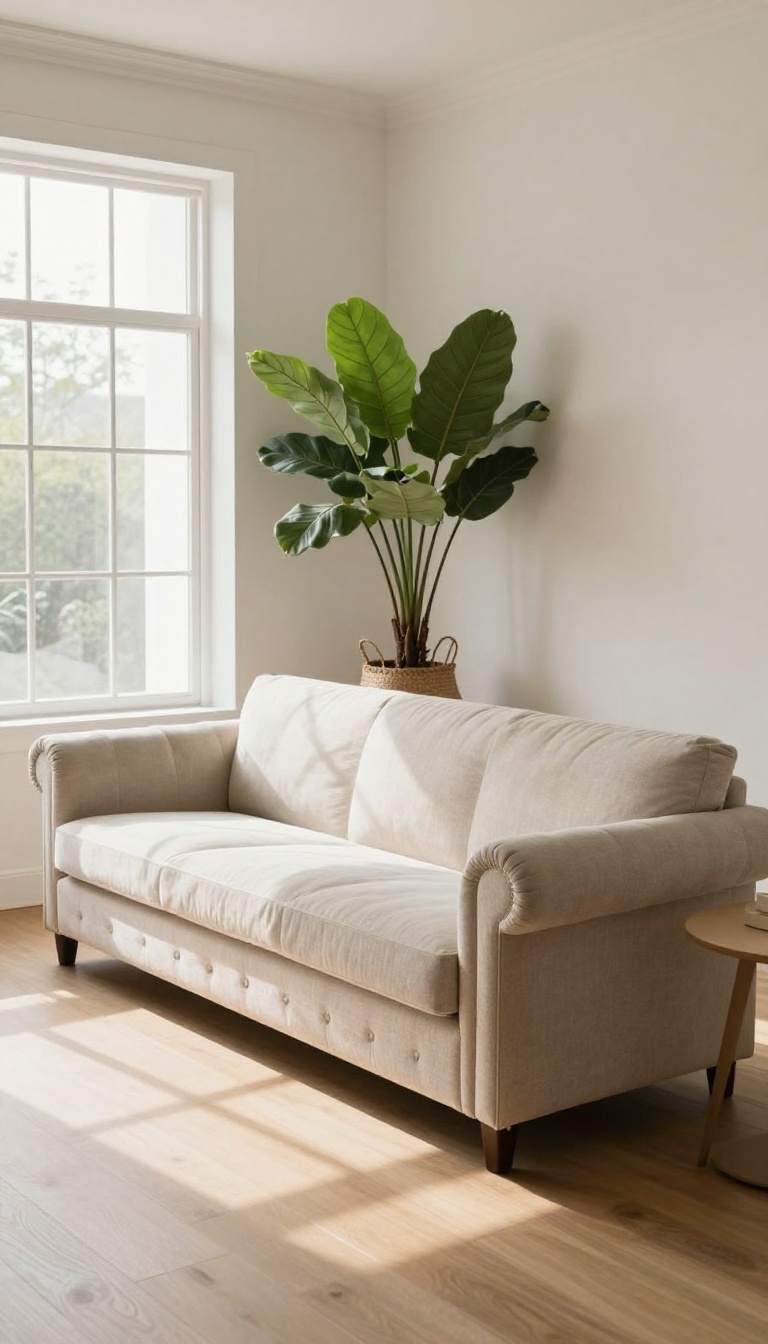
Chesterfield sofas have a way of commanding a room, but that strong presence can sometimes make a space feel a little too buttoned-up. A large plant softens that formality and brings a welcome dose of nature indoors. It also draws the eye upward, balancing the low, heavy lines of the sofa with vertical greenery.
You don't need a jungle—just one well-placed plant can do the trick. Think of it as a living sculpture that adds color, texture, and a breath of fresh air. The key is picking a plant with enough height and volume to hold its own next to a substantial piece like a Chesterfield.
Pick A Plant With Presence
A fiddle leaf fig is a classic choice, with broad leaves that create a lush, dramatic look. If you want something more architectural, a snake plant offers sharp, upright leaves and thrives on neglect. Both can grow tall enough to make a statement without overwhelming the room.
Style It In A Woven Basket
Skip the plastic nursery pot and tuck your plant into a woven basket or a textured ceramic planter. This small swap adds warmth and ties in with natural materials elsewhere in the room. A basket also gives you flexibility—just lift the plant out when it's time to water.
Place It Where It Counts
Position your plant to the side of the sofa, not directly in front of it, so it doesn't block conversation or sightlines. A spot near a corner or beside an armrest works well. If you have a dark corner, a plant can brighten it instantly and make the whole room feel more alive.
9. Rethink Your Lighting with a Floor Lamp
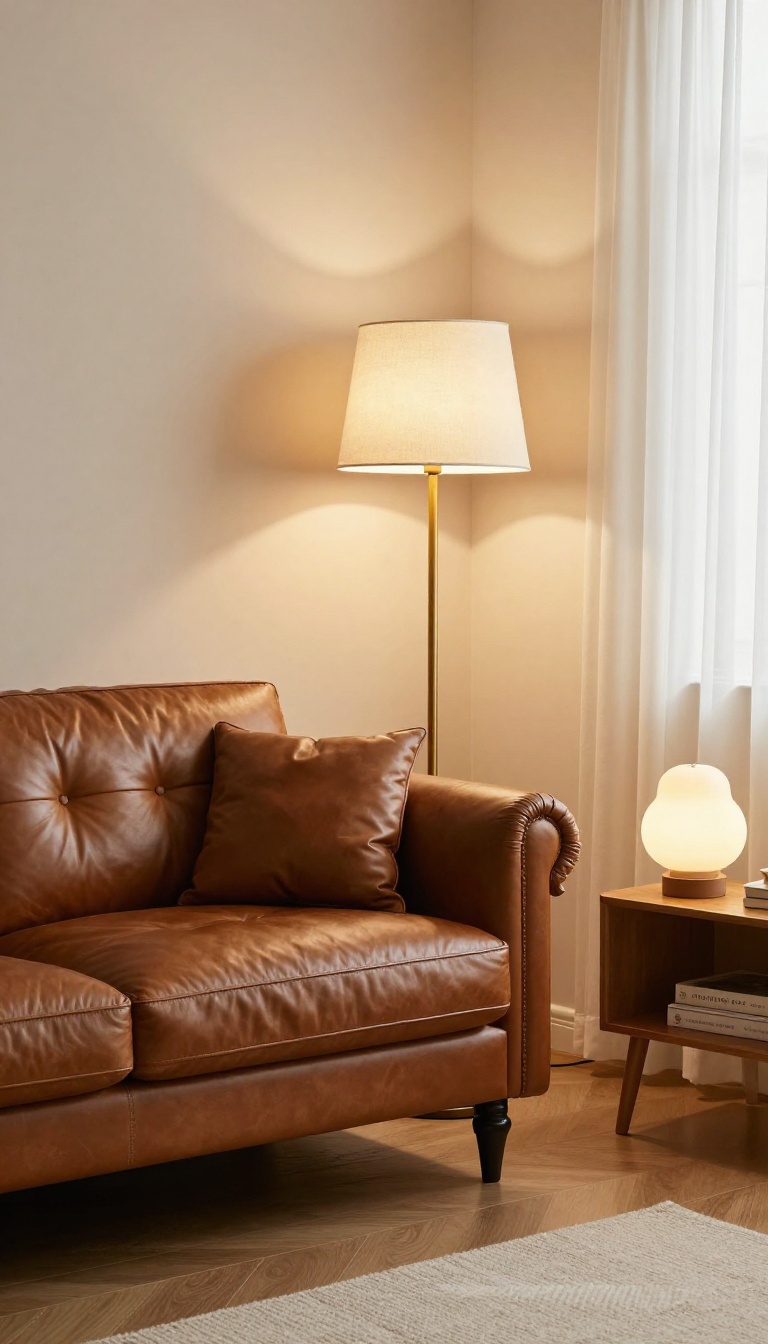
One overhead light can flatten a room and make your Chesterfield look more like a showroom piece than a place to curl up. Swap that single bright source for a warm floor lamp and a table lamp, and you instantly create cozy pools of light around the sofa. It's a small change that shifts the whole mood from harsh to inviting.
Floor lamps are also practical because they don't require wiring or a handyman. You can place one near the arm of the sofa, angle the shade toward the cushions, and suddenly the tufted details look rich instead of rigid. Add a small table lamp on the other side, and you've got balanced, layered light that makes the room feel lived-in.
The goal is to stop lighting the whole room evenly and start lighting the areas you actually use. A floor lamp with a warm bulb (around 2700K) becomes your main source for reading or chatting. A table lamp on a side table fills in the opposite corner so the light doesn't feel lopsided.
Together, they create a soft, welcoming glow that flatters the leather or fabric of your Chesterfield. You don't need matching lamps, either. In fact, mixing a slim metal floor lamp with a ceramic table lamp adds a nice bit of character.
Just keep the shades in similar tones—like linen or warm white—so the light feels cohesive. Dimmer switches or smart bulbs let you dial the brightness down for movie nights and up for conversation.
Pick The Right Floor Lamp
Look for a floor lamp with an adjustable arm or a shade you can tilt. That way you can point light directly at your reading spot or bounce it off the wall for a softer effect. A slim base takes up less visual space, which keeps the Chesterfield as the star.
Avoid anything too ornate—simple lines feel more modern next to all that button tufting.
Add A Table Lamp For Balance
A table lamp on a side table or even a small stool works wonders. It fills the gap on the opposite side of the sofa and makes the lighting feel intentional. Choose a shade that's wider than the base for a relaxed look.
If you have a dark corner, a table lamp with a metallic base can reflect a little extra warmth.
Use Warm Bulbs And Dimmers
Bulb color matters more than you think. Warm white bulbs (2700K–3000K) make leather look richer and fabric feel softer. Add a dimmer plug or smart bulb so you can lower the light without losing the cozy factor.
That way, one lamp can go from bright enough for reading to soft enough for winding down.
10. Keep the Rest of the Room Simple
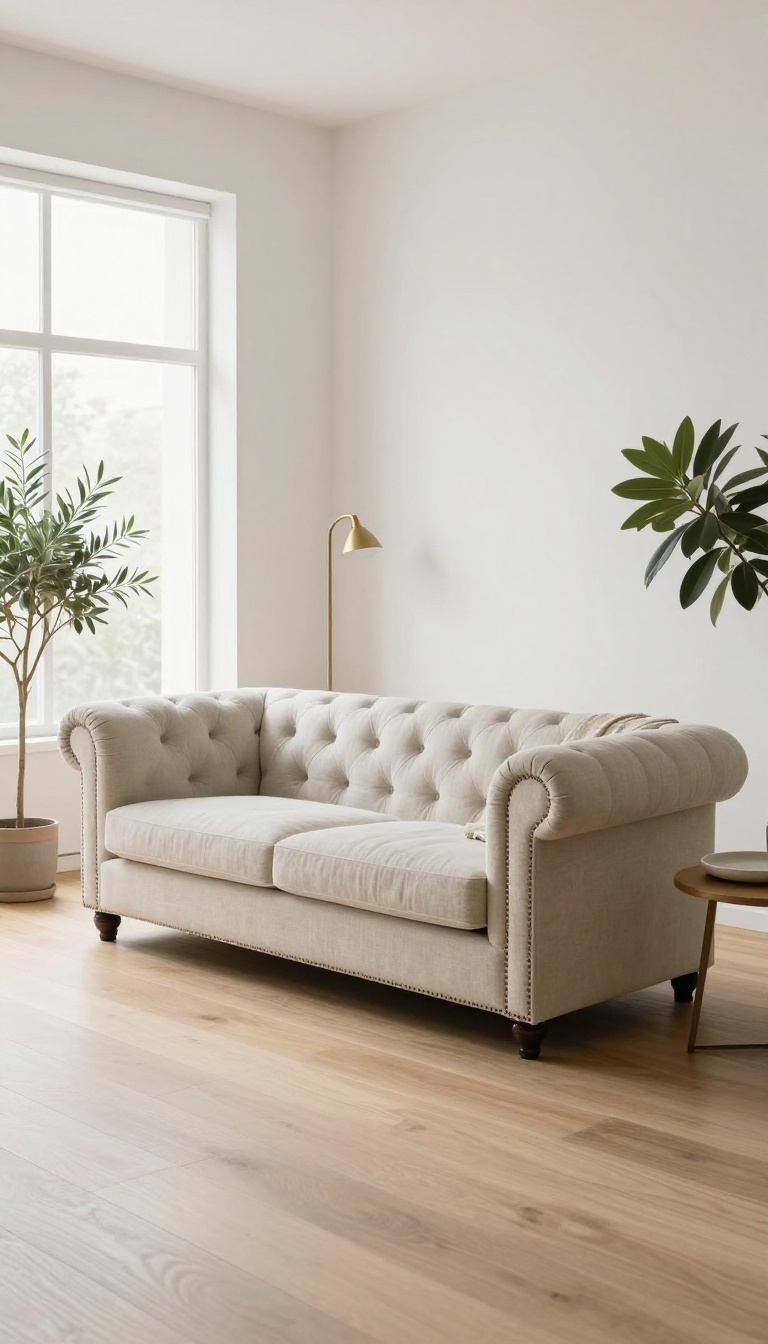
Your Chesterfield already does the heavy lifting. Piling on more pattern, color, and stuff just creates noise. The trick is to step back and let the sofa breathe.
That means plain walls, open floor space, and only a handful of accessories that earn their keep. It’s less about doing more and more about editing what’s already there.
A Chesterfield has a lot going on: deep button tufting, rolled arms, nailhead trim. When you surround it with busy wallpaper, stacks of pillows, and shelves full of knickknacks, the eye has nowhere to rest. The sofa stops looking special and starts looking like one more thing in a crowded room.
Simple doesn’t mean boring. It means giving your sofa a calm backdrop so its shape and texture stand out. Think of it like framing a piece of art—the frame shouldn’t compete with the picture.
You can still add personality. Just be picky. A single bold lamp, a textured throw, or one large plant can do more than ten small tchotchkes.
The goal is a room that feels collected, not cluttered.
Choose A Quiet Wall Color
Warm whites, soft greys, and muted beiges let the Chesterfield’s silhouette pop. If you want a little depth, try a tone-on-tone approach with slightly darker trim. Skip loud patterns or murals—they fight the buttoning for attention.
A calm wall also makes the room feel bigger and brighter.
Limit Accessories To A Few Key Pieces
Pick three to five items max: a floor lamp, a side table, a framed print, maybe a tray for remotes. Each piece should have a job or bring you joy. Rotate accessories seasonally instead of buying more.
That way the room stays fresh without feeling full.
Keep Floor Space Open
Avoid tucking lots of small furniture around the sofa. A clear path to the seating makes the room feel inviting. If you need extra seating, choose one larger chair instead of two small ones.
Open floor space also shows off the Chesterfield’s legs and profile.
FAQ
Can a Chesterfield sofa work in a small living room?
Yes, especially if you choose a two-seater or a low-profile version. Keep other furniture slim and avoid heavy drapes to prevent the space from feeling crowded.
What colors go best with a Chesterfield sofa?
Neutrals like cream, gray, and taupe always work, but you can also pair it with jewel tones or soft pastels for a fresh contrast. Just keep the overall palette to three main colors.
How do I make a Chesterfield sofa look less formal?
Add casual textures like a chunky knit throw, a linen slipcover for the cushions, or a jute rug. Mixing in modern or rustic pieces also helps relax the look.
Should I put a rug under my Chesterfield sofa?
Absolutely. A rug anchors the seating area and adds warmth. Choose one large enough that at least the front legs of the sofa sit on it.
What kind of coffee table suits a Chesterfield sofa?
A round or oval table in wood, glass, or metal works well to balance the sofa's straight lines. Avoid heavy, ornate styles that compete with the tufting.
Conclusion
You do not have to try all ten ideas at once. Pick the one that solves your biggest annoyance, whether that is a cramped corner or a sofa that feels too formal, and test it this weekend. Small shifts often teach you more than a full redesign.
Chesterfields are forgiving that way. Live with your change for a week, watch how the room actually gets used, then adjust from there. The best version of your living room is the one that fits how you really live.